
Quick Links:


Now playing: “From Gunsmoke to Yellowstone: How Westerns Have Evolved”
Listen wherever you get your podcasts.
A deep look with a deep brew!
.png)


The Invite makes us think about our own red line
Annapurna Pictures, 2026
Director/Writer:
Olivia Wilde / Cesc Gay, Will McCormack, and Rashida Jones


Reading Time:
7 minutes
📷 : Annapurna Pictures
Honeybush:

Nonfamily dramas with strong adult and/or socioeconomic themes
Barley:

Movies and TV shows with a lot of dialog
Reba Chaisson
2026-07-24
I bet many of us think of ourselves as guarded in our initial meetings with someone. But consider what we have talked to people about who happen to be sitting next to us at a Cubs game, standing near us while we wait for our tea at The Coffee Bean & Tea Leaf, or even waiting in line to get into Universal Studios. I am not sure about you, but I have overheard exchanges about significant others and even financial portfolios between people who are as likely to see each other again as I am to grow wings drinking Red Bull. Perhaps, then, sharing this information is “no harm, no foul” as they say. But it does make you wonder where the red line is, and at what point do we no longer consider the person a stranger. Interestingly, Olivia Wilde’s The Invite raises these questions in a way that is more inviting (pun intended) than ominous.
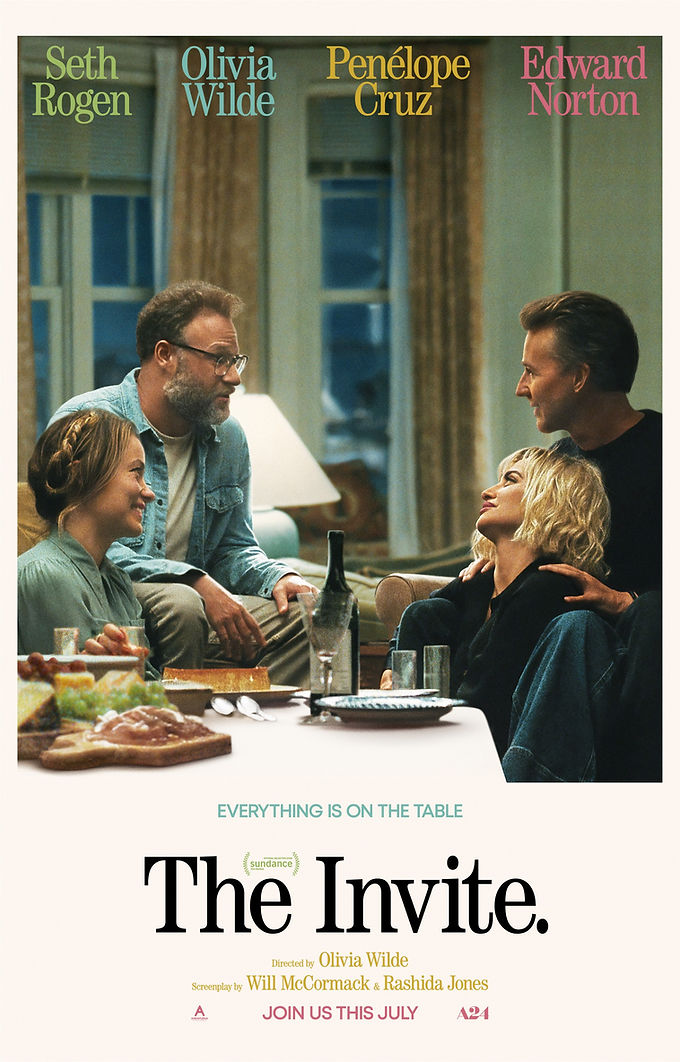
Starring Seth Rogen and Olivia Wilde, The Invite is about a married couple who reluctantly invite their new upstairs neighbors to their apartment for dinner. We realize their reluctance when Joe (Seth Rogen) arrives home from work and is disappointed to learn that the dinner is scheduled for that night. He “can’t stand” the couple they invited to their home because they make a lot of noise upstairs. “Can’t we just cancel and reschedule?,” he asks; “my back hurts.” To which his wife, Angela (Olivia Wilde), gives a quick, flat, unequivocal “no.” A music teacher at a small San Francisco college conservatory, Joe constantly complains of back pain and says he is not feeling up to doing anything in the evenings.
The film opens with about fifty college students practicing orchestral music on a stage in a school performance hall while Joe looks on, appearing disengaged. As the band finishes the piece, they await his response, which doesn’t come until one of the students prompts him. He mutters something disingenuously complimentary and encourages them to continue practicing, while he scoots out of his seat, rushes toward the exit, clumsily grabs his bike, and rides home. If this scene doesn’t make it clear that Joe is either dispirited by his students’ underwhelming performance or uninterested in being in the otherwise empty auditorium, nothing else can.
Angela is a stay-at-home mom who recently remodeled their upscale apartment and is anxious to show it off. But when she realizes Joe forgot to pick up the wine on his way home, she becomes incensed and obsesses over what will be served with the cheese dish she has toiled over for hours. As they argue over his neglectfulness, Angela locates a bottle of champagne, and the two of them nearly finish guzzling it just as their guests ring the doorbell.
The contrast between Angela’s preoccupation with the food and wine and Joe’s agitation about the gathering speaks to differences in women’s and men’s handling of such events. As hosts of gatherings, women are not only tasked with handling invitations, preparing food, and making arrangements that ensure all runs smoothly, but they are expected to manage the affair and be its energy source in real time. It is physical, psychological, and emotional labor. Men, however, are largely expected to look nice and show up. And few if any are concerned when men spend the entire party hanging out with the people they already know or being content sitting alone when they don’t. They are typically not expected or tasked with floating from group to group to make small talk.
Inviting a couple to your home, however, requires men to engage the group and at times indulge in conversations they would rather not. Perhaps this explains Joe’s agitation and his insistence that they postpone the dinner. The gathering will require him to engage with people he is unfamiliar with, potentially making him uncomfortable in his own home. He even acknowledges this when his guest says something he finds off-putting and angrily retorts that he will not be made uncomfortable in his own home. With large parties, you can hide in the crowd. With two dinner guests, not so much.
The levels of preparedness for the evening convey a sense of each couple’s thoughts on formality. Even after being reminded that the dinner is tonight, Joe doesn’t change out of the khakis and now unbuttoned denim shirt he wore to work and rode his bike back home in. As for Angela, her hair remains unfinished—still loosely pulled up into a thick crossbraid as if to keep it out of her face while she prepped throughout the day. Their neighbors, Hawk (Ed Norton) and Piña (Penélope Cruz), on the other hand, are clean and dressed stylishly casual for the occasion. This contrast in self-presentation compounds the palpable awkwardness and disconnect between the couples to start off the evening. Ironically, where the guests, Hawk and Piña, appear relaxed and ready for the evening, the inviting couple seems stiff and uncomfortable, having not even made themselves presentable for the affair.
During the evening, Hawk and Piña broach intimate topics about their private lives before cajoling Joe and Angela to reveal deeply personal information about themselves. The guests not only make assessments about their hosts based on these revelations, but they propose that they engage not only in different experiences but a different lifestyle. From nearly the beginning of this film, every line of dialog is carefully and deliberately inserted as a building block to this moment: Joe and Angela not being on the same page about having the dinner and their subsequent incessant arguing over the matter. Hawk and Piña’s calm but confident demeanor from the moment they walk in the door neutralizes the rancor. Joe and Angela remain ill-prepared for the evening in terms of dress, as contrasted with Hawk and Piña’s arrival in clean style.
This movie reminds me of the analogy about the frog. If you put a frog in boiling water, it will jump out. But if you start out with cool water and gradually heat it up, even to boiling, the frog will remain in the water through its demise. In effect, Joe and Angela are caught off guard. This puts them at a disadvantage in the conversations and makes them susceptible to suggestions they otherwise might not have indulged, given the limited time they had spent with their guests. On the other hand, it is interesting what people will share with strangers that they will not share with people closest to them.
Dinner party scenes in movies across genres typically function to expose big secrets and lies, like extramarital affairs between guests, someone going broke, the break-up of a relationship, and yes, a marriage in trouble. Dinner guests typically gawk at the spectacle of the downfalls, and rarely are the friends genuinely sympathetic or helpful during these moments. Watch the first two seasons of Your Friends & Neighbors, the 2016 movie, Perfect Strangers, or the 1991 film, The Prince of Tides for perfect examples of these, although as my mom would say, “there’s plenty where that came from.” The Invite, however, never gets so dark and heavy that you want to leave it.
What is also distinct about The Invite is it never gets around to the sit-down dinner, which makes me wonder if the characters’ varying proximity to one another throughout the film helps balance the comedy and empathy so well, and prevents it from slipping into a story that is tonally different and less inviting. (See, I did it again.) But Oscar winner Penélope Cruz and Oscar nominee Ed Norton probably had a lot to do with this too!